Loading…

Loading…
Also known as: Narayana, Hari, Vasudeva, Padmanabha
The preserver of the universe, who sustains cosmic order and incarnates across ages to protect dharma.
Significance
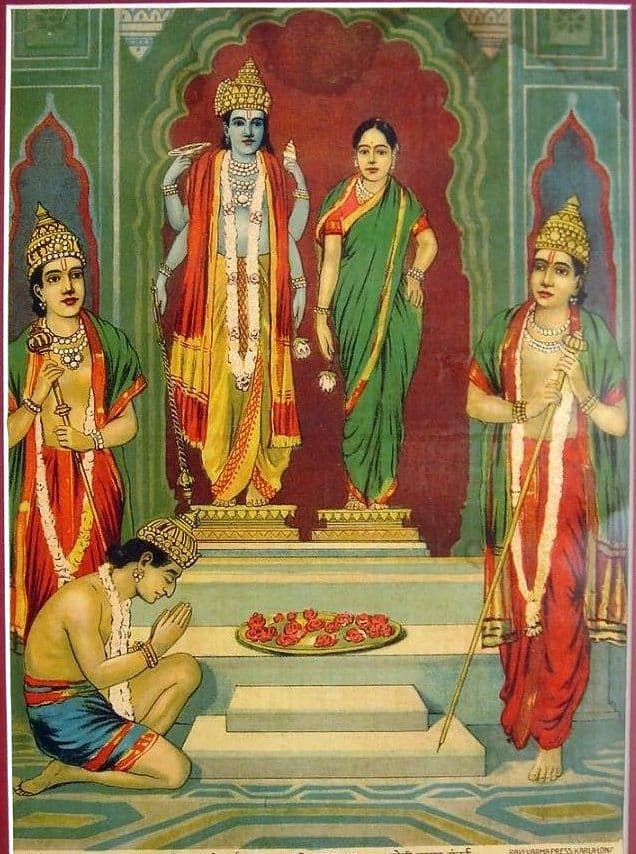
Vishnu is the second of the Trimurti, entrusted with maintaining balance between creation and dissolution. He is believed to descend to earth in various avatars — Rama and Krishna foremost among them — whenever righteousness weakens. Devotion to Vishnu centers on surrender (sharanagati) and steady moral order.
Iconography
Four arms bearing conch, discus, mace, and lotus; blue-hued skin; reclining on the serpent Shesha in the cosmic ocean; carried by the eagle Garuda.
Festivals
Traditional Vaishnava mantra (Taittiriya Aranyaka / Narayana Upanishad tradition)
ॐ नमो नारायणाय
Om, salutations to Narayana.
Traditional dhyana verse preceding the Vishnu Sahasranama (Mahabharata, Anushasana Parva tradition)
शान्ताकारं भुजगशयनं पद्मनाभं सुरेशं विश्वाधारं गगनसदृशं मेघवर्णं शुभाङ्गम् । लक्ष्मीकान्तं कमलनयनं योगिभिर्ध्यानगम्यम् वन्दे विष्णुं भवभयहरं सर्वलोकैकनाथम् ॥
Of tranquil form, resting on the serpent-couch, lotus-navelled, lord of the gods; support of the universe, boundless as the sky, cloud-dark and radiant of limb; beloved of Lakshmi, lotus-eyed, reached by sages only through meditation — I bow to Vishnu, remover of worldly fear, sole lord of all realms.
Traditional invocatory verse, Mahabharata tradition
शुक्लाम्बरधरं विष्णुं शशिवर्णं चतुर्भुजम् । प्रसन्नवदनं ध्यायेत् सर्वविघ्नोपशान्तये ॥
One should meditate on Vishnu, clad in white, moon-hued, four-armed, and serene-faced, for the pacifying of all obstacles.
Mahabharata, Anushasana Parva 149 (preamble to the Vishnu Sahasranama)
यं ब्रह्मा वरुणेन्द्ररुद्रमरुतः स्तुन्वन्ति दिव्यैः स्तवैः वेदैः साङ्गपदक्रमोपनिषदैः गायन्ति यं सामगाः । ध्यानावस्थिततद्गतेन मनसा पश्यन्ति यं योगिनो यस्यान्तं न विदुः सुरासुरगणा देवाय तस्मै नमः ॥
Whom Brahma, Varuna, Indra, Rudra and the Maruts praise with celestial hymns; whom the Sama chanters sing through the Vedas with their limbs, syllables, sequences and Upanishads; whom yogis behold with minds fixed in meditation; whose end neither gods nor demons have known — to that God, salutations.
Traditional Vaishnava prayer verse, widely used in daily liturgy
कायेन वाचा मनसेन्द्रियैर्वा बुद्ध्यात्मना वा प्रकृतेः स्वभावात् । करोमि यद्यत् सकलं परस्मै नारायणायेति समर्पयामि ॥
Whatever I do — by body, speech, mind, senses, intellect, or simply by the nature I was born with — I offer all of it to the Supreme, to Narayana.